Total Pageviews

Saturday, January 5, 2019

Day #3 Jan 5th 2019 - Mexico Rocks and Playa Blanca

Greetings from Belize Marine TREC in San Pedro, Ambergris Caye, Belize! I am writing this blog after dinner, as the students are hard at work on the first sections of their lab reports.

Today was a long and eventful day with 7+ hours spent on the water. We saw a tremendous variety of wildlife today and made great progress on formalizing our research project.

After a hearty breakfast of French toast and biscuits at 8AM, we lotioned up and headed to the beach, boarding our research vessel Goliath at around 9AM. Today's first site is the farthest northern point we will venture, about 15 miles south of the Mexican border. It took us about 1:15 to chug our way there through calm seas and blue skies dotted with white clouds:


Along the way, we held a lab meeting to discuss the students' ideas for our research project. Everyone made helpful contributions as we honed in on a unified research question:


We were greeted by a group of 3 dolphins who swam alongside and under the boat for about 10 minutes. It was a great sight and it turned out to be a portent of even better encounters to come:


We arrived at our snorkel site, called Mexico Rocks. This is a Marine Protected Area, part of the Hol Chan Marine Reserve. As such, there were many rules and guidelines that governed our activity. To start, a park ranger pulled alongside, collected fees, and issues wristbands. This helps to limit the number of park visitors allowed in each day:


We spent about two hours on a guided tour of a large set of patch reefs that were teeming with a wide variety of colorful wildlife. We saw dozens of species of coral, sponge, anemones, and fish. Below is a small sampling of what we saw:


The last photo shows a group of squid that we surrounded and watched for several minutes. The squid communicate with each other through color changes below their skin, causing them to cycle through several colors as we watched, from clear to yellow to purple to black. It was fascinating to watch!

Toward the end of our tour we came upon Belize Reef Enemy #1: the lionfish. This invasive species is designated "kill on sight" - they do so much damage to the reef populations that everyone is asked to kill them immediately. Our guide successfully speared this fairly large specimen and added it to a collecting bucket on board:


Yay for dead lionfish! From Mexico Rocks, we motored to a large underwater cave. Students were encouraged to dive down as far as they dared:


While parked at this site, we had some wonderful wildlife encounters. See the videos below!


We were all quite excited to see a dolphin so close. In fact, I'm not sure I've ever seen a group of students so excited! Everyone loves the megafauna.

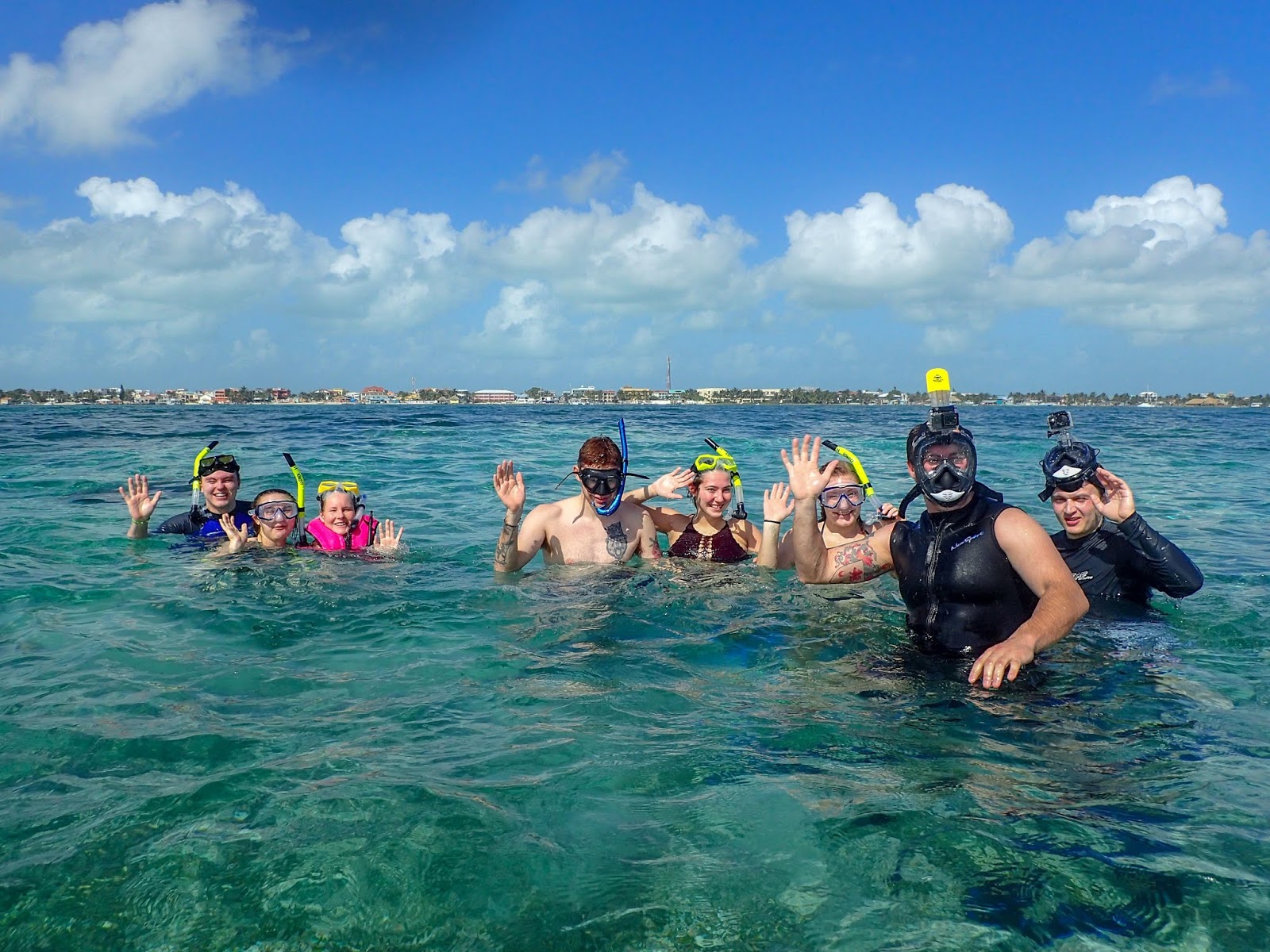
We drove a few minutes to our last site of the day, a reef called Playa Blanca. Here, the students practiced their laboratory data collection, trying out their ideas to see how practical they are in the open ocean. While there, we also enjoyed the reef and its abundant marine life:


Playa Blanca was also our first up-close encounter with a nurse shark. They are quite safe and gentle, and nearly everyone had "shark encounter" on their Belize bucket list:


It's easy to become overwhelmed by the sheer number of sights to be seen on a tropical coral reef, or to be caught up in cataloging all that one can see. But every once in a while, one can't help but be struck by the sheer beauty of this ever-changing seascape:


The lab practice was helpful, and we spent our boat ride back discussing how to improve our protocol. We arrived back at the beach around 4:30PM, all a bit crisp, salty, and quite satisfied. We convened in the TREC classroom at 5:30PM for an hour long lab meeting during which the method for our lab project was finalized. As I type, students are finishing dinner and preparing to get to work on their lab reports afterward.

All is well here, although I will say that there seem to be more sunburns than usual. I'm on them, don't worry! SPF50 for everyone! Otherwise, there are no significant problems and every student is availing him or herself well and appropriately. Thank you to New England College for providing us all with this opportunity!

Thanks for reading!

- Eric J. Simon, Ph.D., Professor, Department of Biology & Health Science, New England College

Friday, January 4, 2019

Day #2 (January 4, 2019) - Tropical Reef Education Center, San Pedro, Belize

Greetings from sunny, hot, humid Belize! I am writing this after another fine dinner (fried chicken, salad, mashed potatoes, corn, rice and beans, brownie) in the main gathering room of TREC. Around me students are researching the relationship between coral diversity and fish diversity in preparation to start working on our research project tomorrow. The air is hot and sticky, fans are blowing, and everyone is happy, well fed, and excitedly talking about our day.

Every day at Belize Marine TREC begins with a healthy 8AM breakfast featuring eggs and tropical fruit:


At 9AM, everyone gathered their gear, put on a heavy coat of sunscreen, and walked the few blocks to the beach:


Once called by the captain, we worked our way down the dock and, with the help of a steady hand from our guides, boarded the large catamaran that will serve as our research vessel for the week:


We motored about 20 minutes to our first snorkel site: Pillar Coral. At each site, TREC Director Dr. Ken gives us a briefing about what we'll see and how to see it safely:


At the back of the boat, we donned our snorkel gear and entered the water:


The purpose of today was to get used to snorkeling in the ocean, so we began at sites that are relatively calm, shallow, and free of hazards. Each dive begins with a guided tour where we follow our licensed tour guide through the reef. Once that is complete, everyone is free to split into buddy pairs and explore the same region on their own. Everyone seemed very psyched to be in the water, seeing all the sights that they had spent an entire semester learning about:


We spotted a wide variety of wildlife, including many species of fish and a southern sting ray. Our dive at this site lasted about 90 minutes. Afterward, everyone talked about what they saw, wrote in journals, ate lunch, and relaxed as we slowly motored our way to the next site:


Our next stop is a reef called Tres Cocos. Again, we were led on a guided tour, followed by some buddy snorkeling. And again, students saw and were able to interact with a variety of wildlife. The sites we visited today are not protected in any way, so students were able to touch various marine creatures which had previously existed only as computer images:


We emerged from the water exhilarated and a bit exhausted. We returned to the island by 2:30PM, quickly changed and looked at photos, and then gathered for a lab meeting:


The students began to figure out a plan for our research project over the week. Every student wrote down several ideas based on observations made during the day, then passed their notebooks around to share. By the end of the evening, the students had settled upon an investigation of coral diversity and its relationship to fish diversity. We'll be working out the details of our study question tomorrow. Meanwhile, students were encouraged to expand their culinary horizons by sampling some local ceviche, fresh seafood prepared in lime juice. Everyone was game to give it a try:


We headed back to TREC at sunset:


We gathered in the TREC classroom to develop our research ideas and discuss a plan for tomorrow. We then enjoyed the previously described dinner. As I type these final words, the students are hard at working researching background information to inform our project.

Everyone is happy and healthy. We have a few sunburns, bug bites, and coral scrapes, but nothing more serious than that. Every student is taking this opportunity seriously and finding a good mix of fun and scholarship. I'm proud of every one!

Thanks for reading. Look to our Facebook page for more photos. Feel free to comment below and share this link with friends, relatives, etc. Bye for now!

Thursday, January 3, 2019

Day 1 January 3rd 2019 - Boston to Atlanta to Belize City to San Pedro

Greetings from San Pedro, Belize! I am writing this blog post after dinner at our destination. It took us about 13 hours to travel from snowy New Hampshire to sunny Belize.

We met at New England College at 4:15AM and divided into two vans. Thanks to the kindness of our volunteer drivers (thanks MarkM and DanF!) we headed onto the snowy highway. We arrived at Logan, checked 16 bags between us, navigated security, and boarded our first flight just in time.

About 2.5 hours later we arrived in Atlanta and had just enough time to transfer terminals, get a bite to eat, and board our next flight:

(Editor's note: You can click on any image on this blog to see a larger version)

We were all pretty excited when our wheels lifted, knowing that we were after all this time finally one stop away! After about 2:45, we landed at Belize International Airport in Belize City on the mainland. We were immediately struck by the warm moist tropical air as we deplaned. We worked our way through immigration, customs, etc. and into the domestic terminal. We split into two groups because our group of 16 was too big for just one plane! We boarded our Maya Island Air flights, which hold a maximum of 13 (with one student sitting in the co-pilot's seat):


It's interesting to note that several students mentioned this small plane ride as the aspect of the trip about which they were most nervous, but everyone seemed to enjoy it once we were in the air. Our 15 minute flight brought us from the mainland to the island of Ambergris Caye and the town of San Pedro. We gathered our bags, loaded into 3 vans, and drove a short way to our home for the next week: TREC (the Tropical Research and Education Center). We split into rooms (generally four students to a room with two bunk beds and a bathroom):


All the students checked out their snorkel gear and practiced in the pool (while also enjoying the opportunity to cool off and rinse off):


Afterward, the students were encouraged to begin working on their journals by recording their experiences and impressions so far:


At 6:30PM, we gathered for dinner at TREC. Maggie, our cook, prepared Central American cuisine that is familiar to us, usually complemented with an American-style cake for dessert. The addition of the local hot sauce Marie Sharp's always helps! Everyone seemed to get their fill of dinner.


After dinner, we gathered for an orientation by the Director of TREC, Ken Mattes, Ph.D. Ken taught us about the center, what we'll be doing, boat safety, how to properly respect our surroundings, and how to stay safe.


By the end of the orientation, we were all pretty tired from a long and exciting day. I think most of us were happy to retire and dream of our first day on the water tomorrow.

Thanks for reading! Feel free to leave Comments below, and I will make sure the class sees them. Rest assured that everyone is happy and healthy and doing well. Internet on the island can be quite spotty, so never take a lack of communication to indicate a problem - no news really is good news! I will do my best to update the blog each night.

- Eric J. Simon, Ph.D., Professor, Biology & Health Science, New England College

Wednesday, January 2, 2019

Day -1: January 2nd, 2018 - Henniker, NH

It's almost go time! It's always exciting to anticipate our trip. It looks like we should have fine weather for our departure. We are meeting at NEC at 4:15AM tomorrow morning. Very big thanks to Prof. Mark Mitch and Dan Freese and volunteering to drive us to/from Logan airport!

This trip represents the culmination of a lot of work and preparation on the part of the students. We met weekly during the fall semester. During that time, every student had to learn to recognize 70 marine species on sight. This task was reinforced by online practice quizzes and weekly species ID quizzes. All together, students had a total of 193 photos/videos they had to recognize during the semester. Incredibly, two students (RC and CC) maintained a perfect 100% score throughout the semester, correctly identifying all 193/193! Those two students earned themselves a lobster (or otherwise) dinner at a fancy restaurant while in Belize. Great job! All together, the class had a total average of 92% on these quizzes, a remarkable achievement considering that most of the students are non-science majors. Great job everyone! This knowledge will serve us well when we are on the reef.

Our semester also included a trip to the YMCA to practice with snorkel gear and to learn some basics of snorkeling:


Everyone passed and seems ready to hit the reef! In just 1.5 days, these students will be stepping off the back of a boat into a coral reef on the open ocean.

The semester also included some social dinners where everyone was able to get to know each other and bond over their shared anticipation:


By the end of the semester, we had all formed a cohesive group, bonded in our excitement about the upcoming trip!

This blog will be our primary means of communicating while away on the trip. You can sign up for email notifications of blog updates in the box at the top of the blog. You can also follow us on Facebook at https://www.facebook.com/NECBelize/. Feel free to leave messages in the Comments section for me to pass along to the students.

My next update will be while we are en route! Thanks for reading.

- Prof. Eric J. Simon