Total Pageviews

Thursday, January 12, 2017


The coolest thing I saw in/on the water was …
(Click on any photo to see a bigger version)

Catching a white spotted octopus that crawled up my arm, changing color along the way – Elizabeth

I highly enjoyed being able to feed the Tarpon off the dock at Caye Cauker. It was funny with the pelicans trying to take the bait away from the Tarpon.-Taylor

While at shark ray ally getting to feed a blue tang and a southern sting ray.- Emily G
  Getting in the water first with the Nurse sharks and shooting good video of them. Also having the chance to hand feed them.-Chris
While at shark ray alley, getting into the water as soon as we got there to see nurse sharks and rays all around me.    -Jess
Swimming with the sharks, fish, and especially stingrays at Shark Ray Alley and having them swim towards me and all around us for an extended amount of time.  – Ashlynn
As soon as we got in for the night dive Siete was in and he showed us a Balloon Pufferfish, I got to hold it and it was super cute and way softer than I thought it was going to be. – Tara
Swimming with a spotted eagle ray swimming right beneath me, it looked like I was riding the ray like a glider.- Travis
Swimming down to the opening of Mexico Rocks Cave was my favorite part of the trip. There were hundreds of fish guarding the cave entrance.   - Matt

The coolest thing I saw was when we were snorkeling at Mexico rocks and looked up to see a green sea turtle that was swimming by us!-Ainsley
Got to touch a White spotted octopus during the night swim-Megan

Finding and holding a pin cushion sea star the first snorkel we went on – Emily

Swimming with the octopus in my hand for 20 minutes during the night snorkel. I guess it liked me, and just wouldn’t let go. – Will

Swimming with a green sea turtle for the first time because it’s my favorite animal. -Christina

I loved swimming with the stingrays and the green sea turtle!- Alexa

Seeing a Blue tang at coral gardens. I loved being able to see Dori in person. -Jasmine

Seeing a nurse shark in person for the very first time at coral gardens – Daffney

Watching a friendly octopus hitch a ride on a student’s arm for 20 minutes as we swam around during our night dive on Tuffy Reef, and then being able to hold it myself.  - Eric

Wednesday, January 11, 2017

January 10th, 2017
Caye Caulker, Belize

Day #7: A trip to the island that time forgot

We set out today knowing that it was our final day on the island. All of our research was done, our data was collated, and lab reports were being frantically written.

The seas were once against stormy with winds blowing from the north. We knew pretty much from the outset that snorkeling was not going to be possible today:


We gently motored on the Goliath to a nearby island called Caye Caulker (or Key Corker or any one of several other variations):


Caye Caulker is an incredibly mellow place that caters almost entirely to tourists. The island is filled with art shops, snorkel tour operators, shell collectors, barefoot vagabonds, ramshackle inns, and seafood restaurants. We wandered through the town, shopping and chatting up the locals:


Everyone was universally friendly and mellow. We all enjoyed lunch at The Happy Lobster Restaurant followed by ice cream:


The students were given the opportunity to feed some of the local wildlife, giving whole sardines to pelicans and a large school of tarpons who hang out in a pool on one end of the island:


But mostly what we did was soak in the Caribbean cheeseburger-in-paradise vibe of the place. Caye Caulker is the kind of place where you can lie in a hammock to sip a coconut drink, and next thing you know it's a week later. Everyone is super friendly and offers to braid your hair or sell you some local fish or art.


On our way back, we stopped to observe manatees and dolphins; the students love those charismatic megafauna!

After returning to TREC, we all walked back into town for a final dinner on the island. One new experience that all of the students tried and many embraced during this trip was ceviche made from conch or fish. My description of it during the semester made them all a bit queasy, but everyone tried it on the island and most professed to like it.


After dinner, the students walked through town, visiting some of the local shops (always in large groups). It was a nice way to say goodbye to the island, one that we enjoyed so much over the last week.

Everyone is happy and healthy (although there have been a few who came down with a 24-hour type stomach bug, but nothing that was a real problem) and fully embracing the experience. They are working hard and having fun, and to a person have been able to maintain a proper balance between those two priorities.

I have been reading aloud all Comments and messages that are sent, so keep them coming if you care to.

Tune in next blog post for the story of our trip to the mainland!

Best wishes from La Isla Bonita,

- Prof. Eric J. Simon

Tuesday, January 10, 2017

Monday, January 9th, 2017
San Pedro, Ambergis Caye, Belize

Day #6: A 4 Snorkel Day!

Today was the most epic day of our trip so far! We boarded Goliath under windy conditions (again, far from ideal, due to a northern storm that created strong winds, waves, and current) and headed to the Hol Chan Marine Protected Area. This is Belize's oldest and best managed marine park. It has been a "no touch" zone for nearly 30 years and has thrived.

Our first stop was a spot named Shark Ray Alley. Read that name again. How awesome is that? Who wouldn't want to go to Shark Ray Alley? As we slipped into the water, the boat provided chum which attracted about 6 nurse sharks, 10 southern and horseshoe sting rays, and schools of large fish such as horse-eyed jack and blue tang:


The students swam with the sharks and rays, and took turns approaching them closely for photos:


We stayed in the water for over an hour, closely observing all of the fascinating marine life. Several students said that this was their favorite spot of the trip thus far.


When everyone had their fill of charismatic megafauna, we headed to the main part of the preserve. Hol Chan means "little channel" and marks a spot where the ancient Mayans would navigate to the island. It has a deep-water channel and fish that are larger, more abundant, and more varied than any other site in Belize. We were lead on a guided tour that allowed us to observe and interact with a wide variety of marine life:


Highlights included an underwater arch that the braver students could swim through, large schools of grunts, and several green moray eels:


From there, we headed to an unprotected reef to finish our research. Students found two more stands of coral and cataloged them for all species present. We returned to TREC and collated our data. That night (starting around 9PM - that's dedication!) we had a big lab meeting to finalize all of the data gathered and to discuss the format of the lab report.


We returned from the water at about 4PM and had just one hour to dry off, gather our wits, and head back out on to the water for our night snorkel. We sat on Goliath as the sun set behind the island:


After an extensive briefing from Ken about what we were likely to encounter, the sun set, we donned our snorkel gear, were issues underwater dive lights, and were led in 2 groups on a tour of Tuffy Reef at night:


Diving at night is a very interesting and unique experience! Most students expressed anxiety (and a few downright fear) about the experience, and that is warranted. It is very disconcerting to be in such an alien landscape with only a thin beam of light to illuminate a small portal of view. One can't help wonder what lies just beyond that thin beam:


Despite the unquestioned freakiness of the whole thing, every student stepped outside of their comfort zone, put aside whatever fear was nibbling at the consciousness, and pushed their limits.

We saw a lot of interesting life at night, including corals, urchins, various fish (such as the sleeping parrotfish below), eels, and squid.


But the star of the show, the organism that everyone came to see, was the octopus. The octopus of Tuffy Reef are unusually friendly. The seem to enjoy being handled and carried around. The octopus could ink, bite, and/or flee at any moment, but it chose to stay with our group for about 30 minutes, switching from hand to hand and gamely posing for photos. The octopus itself was very soft and slimy, almost hard to keep in your hand, but with very powerful suckers that could latch on to many different objects at once:


We returned to TREC around 8PM for a late dinner, lab meeting, and then early bed. Everyone was pretty exhausted from the day.

Tomorrow is our last day on the island. I will try my best to post the blog on Tuesday night before we leave, but the Internet can be very spotty. I have been waking up an hour before everyone else in order to access the Internet when it is least used - that's why the posts have been coming the morning after.

Thanks for reading! Everyone remains well. We have a few minor illnesses (sea sickness, water-in-the-ear, etc.) and some burns, scrapes, and bites, but nothing that required any attention beyond what our trip medic Megan could provide out of our very well stocked first aid kit.

Bye for now!

- Prof. Eric J. Simon   ejs@ericjsimon.com

Monday, January 9, 2017

Sunday January 8th, 2017
San Pedro, Ambergris Caye, Belize

Day #5: Who can the weather command?

Today was a day domination by forces beyond our control. The same storm system that created a downpour as we walked through town the night before was creating strong winds, waves, and currents throughout the day. It was quite windy, with visible whitecaps, as we made our way to the boat.


Conferring with Captain Ken, we knew that we were not going to be able to stick to our planned itinerary for the day.


We headed out on Goliath and motored southward to a large stand of island-forming red mangrove trees. The mangrove swamp is a vital part of the Belize ecosystem, helping to build and maintain the shore. It also serves as a nursery and habitat for many kinds of fish, some that will move out on to the reef as they mature, and some that stay associated with the mangrove islands.

Unfortunately, the conditions were rough and the visibility was near zero. The students nonetheless gamely entered the water to see what they could see. We all struggled against the waves until we reached the shelter of the islands. Although calm, there was so much turbulence that the silt prevented us from seeing more than a foot in front of us. So the snorkeling was basically a bust.


But the students were able to view the mangrove trees up close and see some of the wildlife that lives upon them, such as snails and crabs.


After struggling to return the boat, the students spotted a manatee in a nearby channel. Although I couldn't photograph the manatee itself, I'm sure you'd rather see photos of students looking at the unseen manatee!  :-)


At that point, our day was pretty much shot in terms of our planned snorkeling activities. We had intended to finish gathering data for our coral survey project, but the conditions were too poor. So we endured a rough, wind-blown and sea-sprayed ride back to shore, arriving around 2PM.

We decided to take advantage of the time we now had to do our work. First and foremost was the final species ID quiz. During the semester, the students had to memorize by sight 70 species that we are likely to encounter. During the fall, students took a series of 11 species ID quizzes with a total of 160 questions. After all that, 3 students had a 100% average. I promised them that anyone who maintained a 100% average on the species ID quizzes would get a free lobster dinner on the island. So it all came down to the final quiz! I prepared 36 photos that I had taken on this trip, and students had to ID the fish, coral, and other marine life. When it was done, the class had a 92% average! That's fantastic, especially when you realize that most of the students enrolled in this course are taking their first-ever college science course. And one student remained with a perfect average. As per the rules, he was allowed to bring a guest to dinner. So congratulations to Willie on your perfect score!


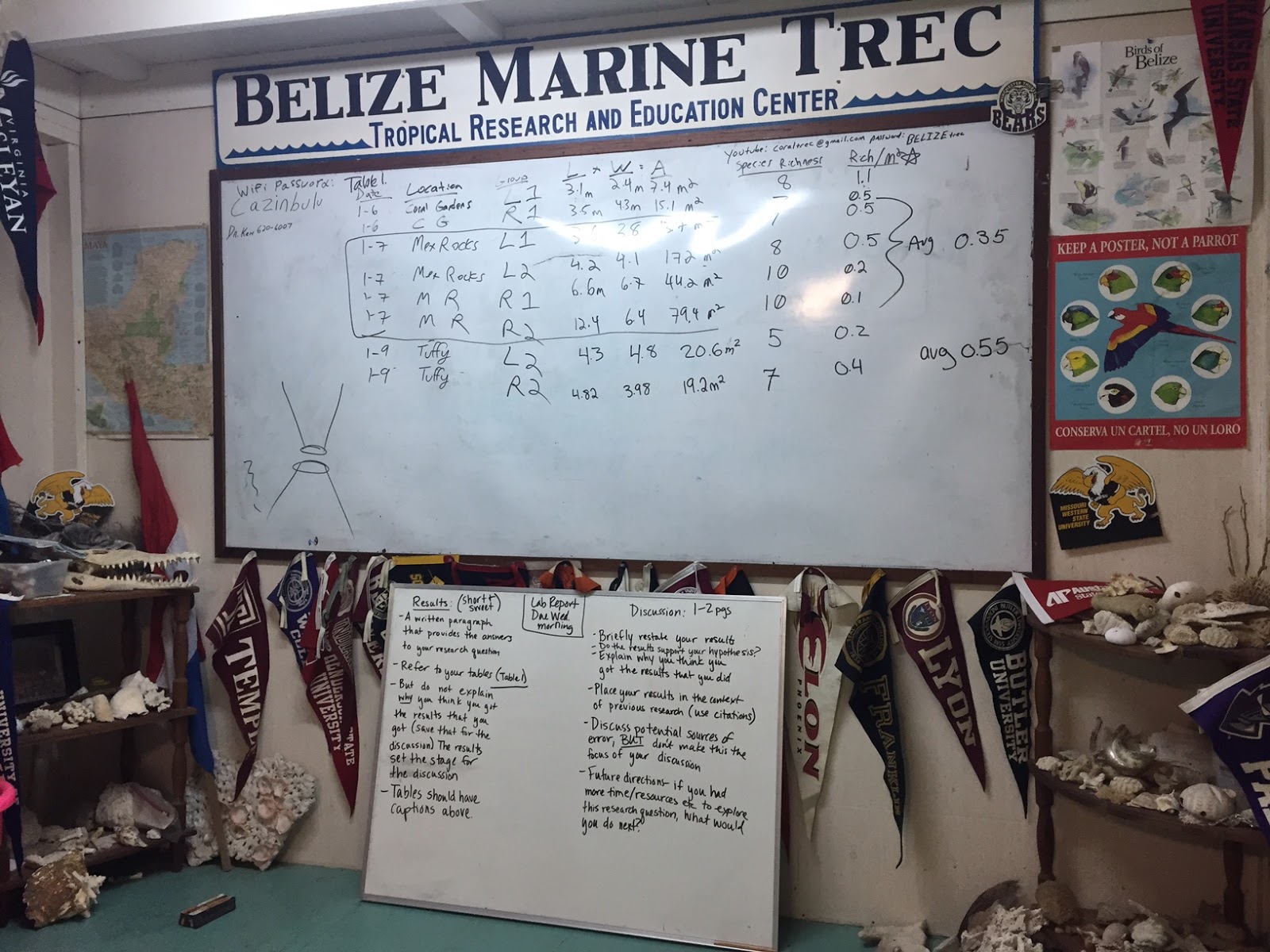
While grounded at TREC, the students also took the opportunity to work on the Results section of their lab reports. They identified every species of coral at their research sites (using photos taken at the time) and combined their data. We still have two more sites to survey, but the results are looking promising.

We have two days left at TREC and on the island of Ambergris Caye. We'll have to wait and see how the weather plans out! Everyone is doing well and working hard. I pass along all comments I receive on this blog. It's fun to embarrass the students by reading comments from their parents.  :-)

Best wishes from Belize!

- Prof. Eric J. Simon