Total Pageviews

Sunday, January 8, 2017

Saturday January 7th, 2017
San Pedro, Ambergis Caye, Belize

Day #4: Mexico Rocks

Greetings from Belize! Today was a day focused on snorkeling and performing research in Mexico Rocks, an officially designated Marine Protected Area near the northern tip of the island (about 15 miles south of the Mexican border).

Our day began with the usual hearty Belizean breakfast of carbs and fruit:


We boarded our research vessel Goliath as usual at 9:15AM:


Goliath is always manned by a crew of 3 or 4. Here you can see Ken Mattes, Ph.D. boat captain and Director of TREC. On the left is Nair (a/k/a Siete), who is an officially licensed marine tour guide. Also pictured are two interns that Ken is hosting for the season:


We gently motored south for about 1:15, which gives us plenty of opportunity to discuss our research plans for the day, and to relax and enjoy the tropical sun:


Upon reaching Mexico Rocks reef, we divided into two research groups and conducted our research. The project was specifically designed to touching anything, since that is prohibited within the protected areas. Students measured coral stands from the surface, and then cataloged and photographed all of the species of coral present.

After that, we all enjoyed guided tours of the reef (you are not allowed to snorkel without being led by an official guide when in the protected areas). Students saw moral eel, nurse sharks, green sea turtles, sponges, and a wide variety of fish:


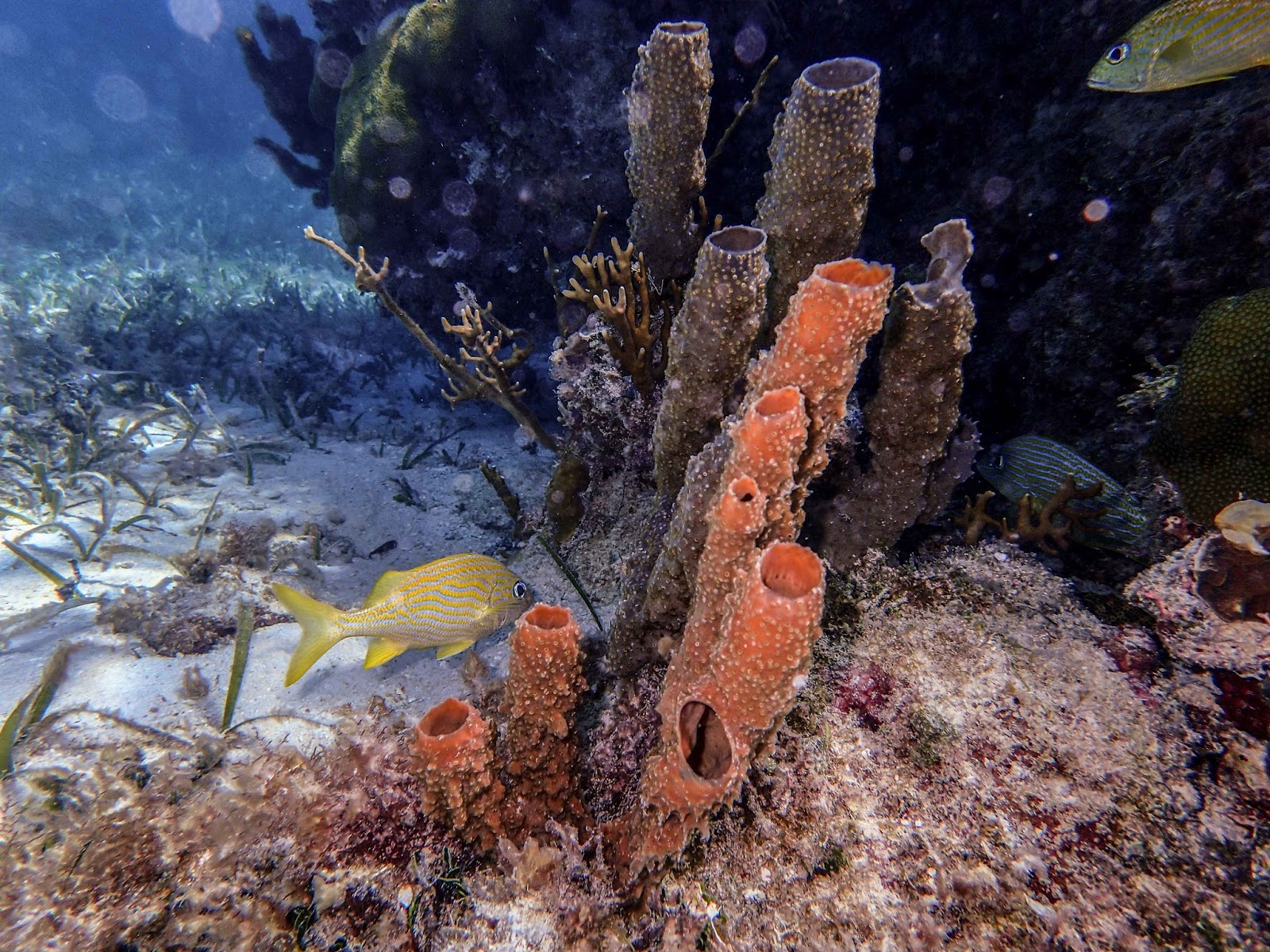
The reef here is among the most beautiful in Belize, rich with beautiful formations of coral and sponges:


After snorkeling the main part of the reef, we moved to an outer area which is famous for having a large underwater cave. The students took advantage of the deep water by entering from the front of the boat (instead of slipping in off the dive platform at the back of the boat, as we usually do):


Once above the cave, the students practiced free diving, popping their ears as they swim downward toward the entrance of the cave. This skill will come in handy later in the trip when students will have an opportunity to swim down and through a large underwater arch:


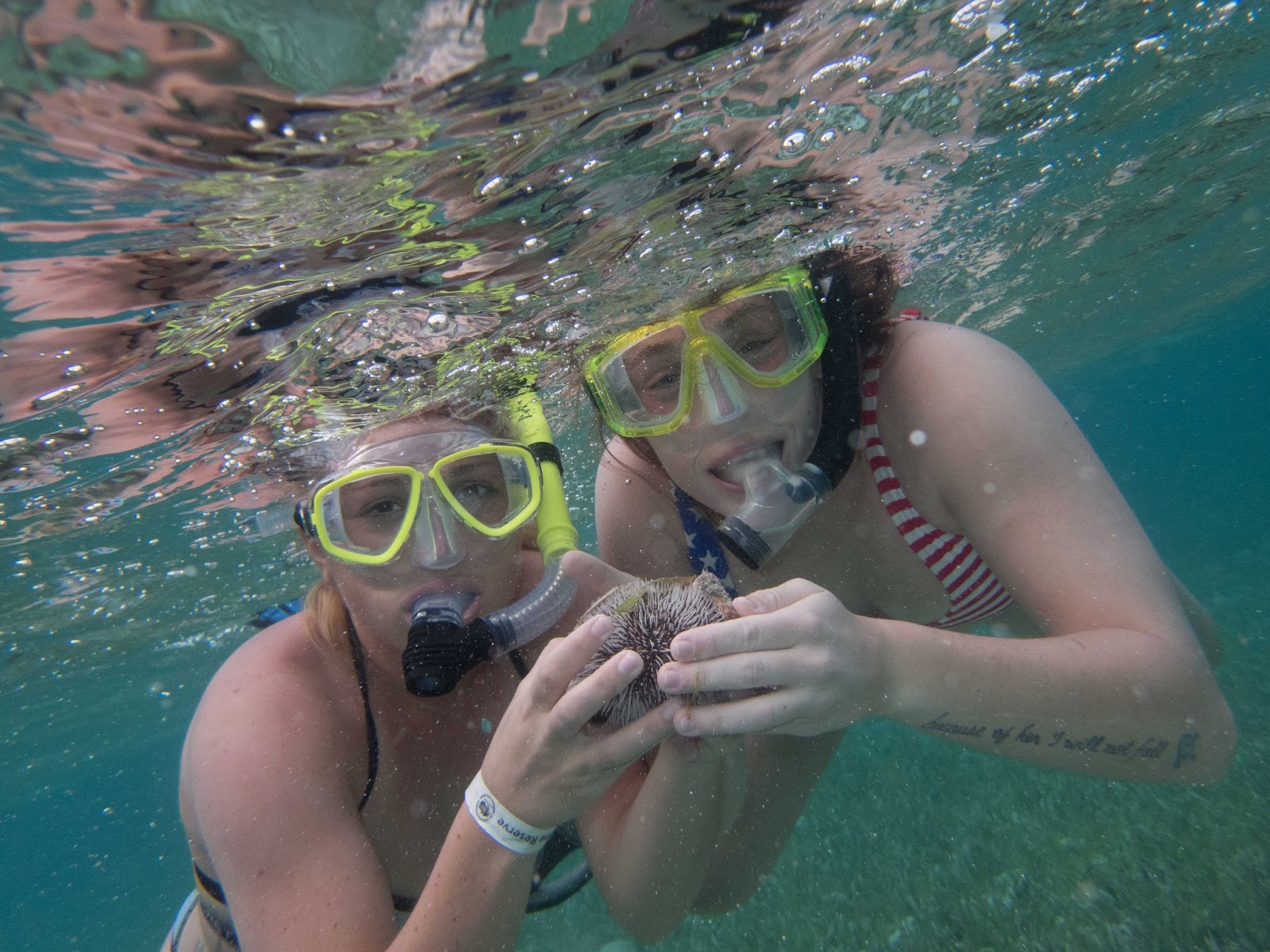
From there, we visited a third spot for the day, a reef called Playa Blanca. Despite a strong current, students enjoyed the shallow reef, and were delighted by a very large spotted eagle ray that circled around us. This area is outside the protected zone, giving students an opportunity to touch some of the creatures:


After about 7 hours on the water, we returned to TREC. All of us were a bit windblown and a bit sunburned:


but class medic Meg reports no injuries among the class so far.

Once back at TREC, the students set to work on our lab projects. The students began to report and share their data. All students worked hard in the classroom until dinner:


After dinner, we all walked into town with the goal of stimulating the local economy. The weather changed to breezy and we were caught in a sudden tropical downpour. That passed, and we all enjoyed some frozen custard and shopping at the local artisans' market. We split up at that point and each enjoyed the Saturday night in Belize.

Everyone is happy and healthy and enjoying the beauty of Belize. Tomorrow will bring some unique snorkeling adventures, so stay tuned!

Best wishes,

Eric J. Simon

Friday, January 6, 2017

Day #3 - Friday January 6th, 2017
San Pedro, Ambergris Caye, Belize

First day of research!

Greetings from beautiful Belize! I am writing this blog entry from an outdoor veranda where we are holding our nightly lab meeting. A wonderful breeze is blowing in from the ocean, cooling down the warm tropical air in just the right manner. Not a bad way to hold a lab meeting!

The purpose of this meeting is to help organize the lab project that all students are undertaking. But let's start at the beginning of the day.

As usual, we enjoyed an 8AM Caribbean breakfast, and then walked to the beach and boarded the Goliath. Today we started with a short trip to the nearest reef, called Tuffy Reef.


After a buddy snorkel (free time touring the reef in pairs), we began to organize our research project. The students have decided to investigate the species richness (i.e. how many different species there are) in conservation reef ares vs. non-conservation reef areas. The students worked at Tuffy to establish a research method. They tried various ideas and tested them out in order to determine a specific methodology.


After lunch on the boat, we moved to another area called Coral Gardens. Here the students put their ideas to their first real test. The students divided into two groups. Each group chose a stand of coral to survey. The measured the dimensions of the stand and then photographed every type of coral present.


It was great to see the students hard at work in the open ocean, working together toward a common goal:


Besides the lab work, the students had plenty of opportunity to explore each of the reefs. Every one of the students embraced the opportunity. I was really proud of how much enthusiasm the students are bringing to the trip!


We encountered a nurse shark sleeping beneath a coral overhang, and several students took the opportunity to "pet" the shark. In case you are wondering, it has leathery, bumpy skin:


We spent a long day on the boat, about 9AM-5PM. It was very sunny, which required us to each apply SPF50 sunscreen about 5 times during the day! Luckily, we all seemed to have won the battle. Other than some minor sunburns and coral scrapes, everyone is healthy.


After a long day on the water, we returned to TREC in time to wash up for dinner. The students seemed to love this meal best of all (tortillas with taco fixings such as chicken, rice, beans, corn, pico de gayo, sour cream, cheese, etc.). All in all, the students give the meals very high praise. Dinner always ends with a large cake (tonight: chocolate).

After dinner we met for a length lab discussion. The students worked on the Introduction section to the lab reports yesterday, and today they are working on the Methods section.


The students are also writing in their journals (which is a graded assignment), and I'm happy at how well everyone is applying themselves. So far, everyone seems to be finding a good balance of work and pleasure.

Tomorrow we will be visiting another reef. This one is protected and so will form an important part of the data we collect. Until then, thanks for reading! And please know that you can see more photo on our Facebook page: http://facebook.com/NECBelize/


Thursday, January 5, 2017

Day #2: January 5th, 2017
San Pedro, Ambergris Caye, Belize

Greetings from beautiful Belize! A few housekeeping notes: you can click on any of the photos shown below to see a bigger version of it. And you can get messages to your loved ones by commenting on the post; I will pass along anything you say. And you can sign up for email notifications of new blog posts (at most one email per day) using the dialog box in the supper left. I do hope to publish a new blog post every night, but sometimes the Internet is not cooperative. Please never take "no news" as "bad news" - it just means that the Internet isn't good that night!

Today was the first real day of our trip and our course. We will soon fall into a daily return of breakfast at 8:00AM and then leaving TREC (Tropical Marine Education Center - our home for the week) for the five minute walk to the beach: 


We all agreed that this is an excellent way to start any day - visiting a picturesque white sand beach lined with palm trees and bordered by turquoise water:


In previous years, we worked every morning to clean the beach. But a major hurricane swept across the island in July 2016, and it greatly altered the ecosystem. The beaches in this area are undergoing construction (building sea walls, trucking in sand, installing breakwaters, etc.) so it really doesn't make sense to clean the beach this year.

Just after 9AM, we walk up the TREC dock and board the Goliath, the research vessel for our trip. The Goliath is a large and comfortable boat, with plenty of space for our entire group of 18, an indoor cabin, drinking water, dive platform, etc.


After about 30 minutes of gentle chugging, we arrived at our first dive site: Pillar Coral. At each site, Dr. Ken Mattes (Director of TREC) gives us a lecture about what we are going to see, the rules for the day, etc.


And then it was time to get in the water for our first snorkel trip!


A typical snorkel trip involves splitting into two groups. Everyone snorkels with a buddy, and each group has a certified guide leading the way. The guide brings us along the reef, pointing out unique features. After 30-45 minutes or so, we are then free to snorkel on our own (with a buddy) for another hour or so.

Thanks to our hard work during the semester (during which time the students had to memorize 70 species by sight) everyone was able to accurately describe what they saw. On this first day alone, we saw many varieties of coral, fish, anemones, lobster, rays, turtles, and even a shark:


Different sites that we visit have different rules of conduct. The sites that we are visiting at first are open in terms of being able to touch what we see. I think it is particular memorable when students are able to touch the organisms of the reef, so I encourage them to do so when we can:


We ate lunch on the boat (as well as Ken's special warm bean dip with chips) and headed back to land around 3PM. Even though we all took great care to avoid sunburns, just about all of us missed a spot or two!

After freshening up at TREC, we visited a local cantina for a lab meeting. The students discussed what they saw today and used that as the basis to design an original research project to be conducted on the reef. The students formulated a plan to compare the diversity of coral at different sites and see if protection status affects the species richness. Tomorrow we will start to work on this project and determine a method. During our meeting, students sample local fare including ceviche and conch. Yum!

After a 6:30PM dinner, the students set to work on their journals and lab reports. As of this moment (after 9PM) every single student is still hard at work writing the introduction section of their report. Good students! I'm proud of you!

All in all it was a great first day. Every student did very well, tried hard, and was enthusiastic about what they saw. The chatter about the experience during dinner was wonderful to hear - so much enthusiasm and so much biology!

Tomorrow we visit two new reefs and formulate our specific research plan. Expect another update tomorrow night.

Good night from Belize, and thanks for reading.

-ejs


Wednesday, January 4, 2017

Day #1: January 4th, 2017
And we're off!

Today was a long day of travel ... but it ended in Belize! Everyone was on time to meet our bus at New England College by 2:45AM. The coach bus drove us to Logan airport:


From Boston, our 7AM flight took us to Atlanta:


Three hours later, we landed in Belize. As we departed the plane, we were immediately struck by the moist, dense, warm tropical air:


We worked out way through immigration, baggage claim, and customs. We then walked across the hall to the domestic terminal to the Maya Island Air desk. After rechecking our bags and obtaining our boarding passes, we went back through security, and then out on to the tarmac to board our small plane for the 20 minute ride to Ambergris Caye. How small was the plane? Well, for one, we had to take 2 planes, because each one only holds 12 passengers (and we are 18 in total). Second, a student was seated in the copilot's seat!


After landing at San Pedro airport, we gathered our bags and took vans to the Tropical Research Education Center, where we are spending our week. All in all, it took us 15.5 hours to get from door to door.

TREC provides everything we need to conduct our research, including sleeping dorms (4 students per room with a shower and bathroom), eating facilities, licensed tour guides, boats for research, equipment, expertise, etc.

After checking into our rooms and unpacking, all the students tried out their snorkel gear in the pool to make sure everything was in proper order. At 6:30PM, we had our first Belizean dinner (spicy chicken, rice, salad, homemade tortillas, and a cake):


The food was plentiful and filling!

After dinner, we all listened to Dr. Ken Mattes, Director of TREC as he gave a safety presentation and orientation:


All in all, it was a long day, but one that can clearly be measured in miles traveled and changes both visible and climactic. Everyone is happy and excited to be in Belize!

Look for another update tomorrow where I will describe our first day on the reef.

Wednesday, December 28, 2016

The Fall 2016 Tropical Marine Biology class has completed all our classroom obligations. They included memorizing 70 marine species by sight, passing 10 species identification quizzes, learning about 5 different marine habitats, and watching/grading two presentation by every student (one on an organism and one on a cultural aspect of Belize).

Next step: Belize! We depart at 2:45AM on January 4th. Get psyched!


Wednesday, May 25, 2016

Our next trip is confirmed!

Tropical Marine Biology has been approved by New England College for the fall 2016 semester.

Our next trip to Belize will take place Jan 4th - 13th 2017!